Factoria is the connectivity, autonomy and intelligence platform developed by DGTIS to transform your industrial equipment.
into intelligent systems, capable of monitoring, adapting and interacting with their environment.



dgtis SA
Factoria is the connectivity, autonomy and intelligence platform developed by DGTIS to transform your industrial equipment.
into intelligent systems, capable of monitoring, adapting and interacting with their environment.
With Factoria, your machines no longer undergo the process. They're part of it.
GEMP
At a time when energy efficiency is becoming as much a strategic lever as a regulatory imperative, the GEMP (Gestion Énergétique des Moyens de Production) project has emerged as an innovative, concrete and connected response to the needs of Swiss manufacturers. Spearheaded by DGTIS, with support from the New Regional Policy (NPR) of the 4 cantons of the Jura Arc and the Swiss Confederation, GEMP aims to integrate energy intelligence directly into production machines.
This project is supported by the New Regional Policy (NPR), a federal program designed to strengthen the competitiveness and attractiveness of regions. This funding contributes directly to the realization and development of the initiative.
GEMP's ambition is simple: to enable OEMs and end-users to control their energy consumption in a fine-tuned, contextualized way. It's no longer just a question of monitoring a building's overall kWh, but of understanding, adjusting and anticipating consumption at the level of each piece of equipment, according to its condition, production cycles and interactions with the industrial environment.
In concrete terms, DGTIS is developing a GEMP software module within Factoria that is capable of :
With over 1,000 machines involved and more than 600 potential customers, GEMP relies on a consortium representing the entire value chain: machine manufacturers, industrial users, engineering schools (notably HE-Arc), and of course the software expertise of DGTIS.
Each player contributes to the creation of a robust, interoperable solution, adapted to the realities of the field. Existing machines can be equipped without being replaced, and new machines are designed from the outset with on-board energy intelligence.
GEMP's innovation also lies in its industrial, software-only approach, which can generate virtual sensors. Where many energy-efficiency solutions are designed for the building or service sector, GEMP focuses on the heart of the process: machine cycles, part quality and cycle time management.
"Our aim is not to slow down production to save energy, but to produce better, smarter, by reducing invisible waste," explains Vincent Noël, CTO of DGTIS.
GEMP does not live in a silo: it is fully integrated with Factoria, the analysis, predictive maintenance and machine interaction platform developed by DGTIS.
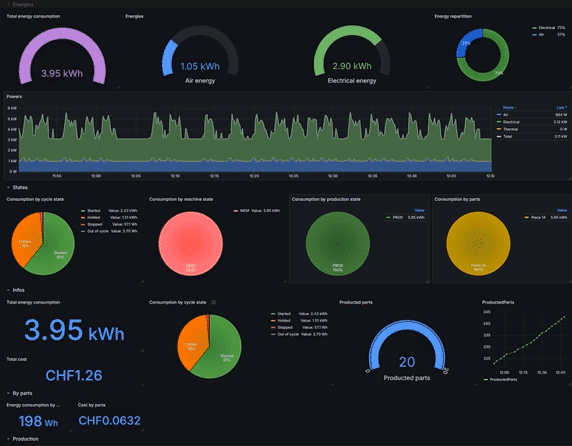
By cross-referencing energy data with quality data, alarms or productivity, GEMP becomes an autonomous source of decision-making in a cognitive factory logic.
In the future, it could even take part in collective control systems, linked to the network or other industrial sites, paving the way for smarter, more responsible and more agile factories.